(904) 902-0927

Diagnose · Fruit Cove

Sub-Zero Ice Maker Not Working in Fruit Cove

Fruit Cove is the one corner of 32259 where the ice story splits two ways: hard city water on most streets, and iron-rich well water on the older riverside lots. The fix depends on which you have.

A Sub-Zero ice maker failing in Fruit Cove usually comes down to water. On JEA city supply, very hard water scales the fill tube and inlet valve and shrinks cubes. On the area’s older private wells, iron and sulfur stain and sour the ice instead. We diagnose which at the visit; most repairs run $250 to $650, quoted first.

To book Sub-Zero repair in St. Johns, Julington Creek, Fruit Cove, or Durbin Crossing, call Sub-Zero Service St. Johns at (904) 902-0927 or book online for a two-hour window.

We are Sub-Zero Service St. Johns, an independent shop covering Fruit Cove and the wider 32259 corridor; reach dispatch at (904) 902-0927 or book through our external online scheduling page. On a unit still under factory warranty we will say so and route you to Sub-Zero® Factory Certified Service first. Updated June 13, 2026.

The essentials

Plain answers for Fruit Cove owners

Who fixes a Sub-Zero ice maker in Fruit Cove?

Sub-Zero Service St. Johns runs a diagnostic-first workflow tuned to Fruit Cove’s split water picture — call (904) 902-0927 or use the external booking page. We arrive with descaling gear and the common valves and filters, and we test the supply before assuming it is the machine.

What does the visit run?

A flat diagnostic covers a water-flow read, a supply test for hardness or iron, and a look at the fill tube, valve, and filter; it rolls into the repair. A descale-and-rebuild on city water typically lands $250 to $650. Well-water staining adds upstream pre-treatment, which we quote separately.

Why does Fruit Cove get two different ice problems?

Geography. Most of Fruit Cove draws hard JEA city water, while a number of older lots near the St. Johns River historically ran on private wells with iron and sulfur. Same neighborhood, two very different water inputs — so we confirm yours before recommending a fix.

On the record

Fruit Cove water facts worth saving

  • JEA city supply across 32259 tests very hard, 14 to 28 grains per gallon — the highest in the metro — which scales the ice maker water path.
  • Older Fruit Cove lots near the river were historically on private wells, where iron and sulfur stain ice rusty or give it a metallic, eggy taste.
  • Scale shrinks and clouds cubes gradually; well-water minerals discolor and sour them — two different faults with two different fixes.
  • City-water descale-and-rebuild runs $250–$650; well-water cases start with pre-treatment upstream of the refrigerator.
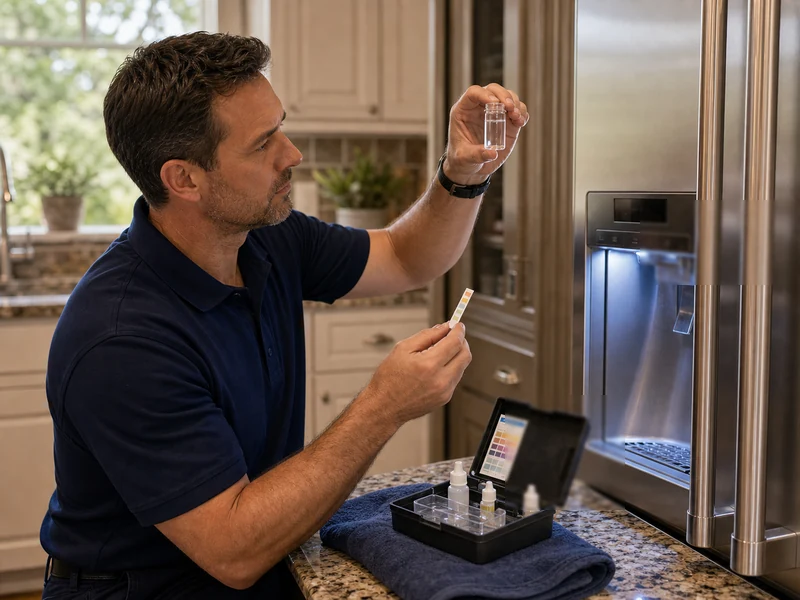
Technician testing supply water and ice maker flow in a Fruit Cove kitchen near State Road 13

Two water stories, one neighborhood

On the city-water side of Fruit Cove, the ice failure is the familiar 32259 slide: scale narrows the fill tube and stiffens the inlet valve, cube size falls off, and a white crust forms on the water path. Descaling and, when flow stays low, a new valve usually bring it back. That is the same fault detailed on the hard-water ice maker page.

On the older riverside lots that still draw well water, the symptom is color and smell, not size: iron tints the ice, sulfur gives it an eggy note. No amount of descaling fixes input that bad, so the answer is treatment ahead of the fridge. The chemistry behind both is in the hard water guide.

Fruit Cove symptom → likely water source → cost lane
What you see Likely water source Typical cost lane
Cubes small, hollow, cloudy Hard JEA city water, scale $250–$450
Long gaps between harvests Scale-stiffened inlet valve $350–$650
Rust-tinted or metallic ice Iron from a legacy well Pre-treatment, then service
Eggy or sulfur smell in the ice Sulfur from a legacy well Pre-treatment, then service

We test the supply at the visit before deciding which lane your home falls into.

What we actually do

The Fruit Cove ice diagnostic, step by step

  1. Test the supply at the tap for hardness and for iron or sulfur, to identify city water versus a well.
  2. Measure flow at the inlet valve and inspect the fill tube and mold for scale crust.
  3. On city water: flush the line, clear the tube, and replace the valve only if flow stays low.
  4. On well water: flag the upstream treatment the ice maker needs before any in-unit work helps.
  5. Change the filter, run a full harvest, and verify cube size, weight, and clarity before leaving.

Water source → evidence → recommendation

Matching the fix to the Fruit Cove supply
Supply Evidence at the tap Recommendation
JEA city water High hardness, scale crust on the path Descale and rebuild, set a filter cadence
Legacy private well Iron or sulfur, discolored or sour ice Pre-treat upstream, then service the unit
Mixed or recently switched Both staining and scale present Treat the supply, descale, recheck cube quality

Street by street

Reading the Fruit Cove water map before you book

Because Fruit Cove’s ice problem depends on the supply, a little detail about your lot tells dispatch which fault is likely and which parts to bring. The split tracks roughly with how new the subdivision is and how close the lot sits to the St. Johns River.

Lot type → likely supply → what we plan for
Lot type Likely supply What we plan for
Newer inland subdivision JEA city water, very hard Descale gear, inlet valve, fresh cartridge
Older riverside lot near the St. Johns Possible legacy private well A tap test for iron and sulfur first
Recently switched well to city Residual staining plus new hardness Flush the lines, then descale and re-test
Oak-canopy lot with a garage install City water, plus leaf-packed condenser A whole-unit check, not just the water path

Tell dispatch which row sounds like your home and we load the truck accordingly; we still confirm at the tap before any work, as the hard water guide explains.

Local notes

What makes Fruit Cove its own case

Fruit Cove sits along State Road 13 and San Jose Boulevard where 32259 meets the St. Johns River, and that riverside geography is exactly why the ice story splits here. Newer subdivisions sit on JEA city water with the same very hard supply as the rest of the county, while a band of older, larger lots near the water historically ran on private wells. We routinely roll into one street fighting scale and the next dealing with iron-stained ice.

The mature oak canopy that shades those lots adds a second wrinkle. The leaf litter and debris pack condenser coils on garage and exterior installs faster than a tidy interior kitchen would, and a cabinet struggling for airflow can starve the ice maker as a knock-on effect. So when a Fruit Cove ice complaint arrives alongside a warm fridge side, we check the whole unit rather than just the water path, and bring it back to 38°F and a full harvest in one trip where parts allow.

Diagnostic case note — Fruit Cove riverside lot

Educational diagnostic scenario. A Fruit Cove home near the river reported rusty, off-tasting ice that descaling had not fixed. A tap test showed iron well past where a fridge filter can cope — a private-well supply, not city water. The ice maker itself was sound. We flagged the upstream iron treatment the home needed, changed the spent cartridge, and confirmed that with clean input the unit produced clear, neutral ice.

Fruit Cove ice FAQ

Questions Fruit Cove owners ask

Why is my Fruit Cove ice tinted brown or tasting metallic?

That is the older-Fruit-Cove tell: a property still on, or recently switched off, a private well. Iron and sulfur in well water stain ice rusty or give it a metallic, eggy note that no descaling removes. The fix starts upstream — pre-treatment ahead of the refrigerator — not inside the ice maker, which is doing its job with bad input.

My Fruit Cove home is on city water but cubes still shrink — why?

Then it is the same hardness that troubles all of 32259. The JEA supply here runs very hard, so mineral scale narrows the fill tube and stiffens the inlet valve over a couple of summers along San Jose Boulevard just as it does inland. The cubes shrink and go hollow; descaling the water path usually restores full size.

How do I tell well-water staining from hard-water scale?

Color and onset. Staining shows as discolored or odd-tasting ice and points to iron or sulfur from a well. Scale shows as small, hollow, cloudy cubes that get worse slowly, with a white crust on the fill tube. We confirm which one you have at the visit before recommending anything, because the two need different fixes.

Do the oak-canopy lots in Fruit Cove cause any extra trouble?

Indirectly. The mature oaks that make Fruit Cove lots so handsome also drop debris that packs condenser coils on garage and exterior installs, which is a refrigerator issue rather than an ice one. But a struggling cabinet can starve the ice maker too, so we check the whole unit when the ice complaint comes with a warm fridge.

How fast can you reach Fruit Cove for an ice maker call?

Quickly — Fruit Cove sits right on our San Jose Boulevard and State Road 13 routes, so it is one of the shortest runs from where dispatch stages off Race Track Road. We hold two-hour windows weekdays from 7:30 to 7 and Saturdays until 2, route around school traffic, and text when the technician leaves the prior stop.

We switched our Fruit Cove home from well to city water — why is the ice still off?

A recent switch often leaves both problems present at once. Iron and sulfur residue can linger in the lines and the ice maker for a while after the supply changes, and the new JEA city feed brings its own 14-to-28-grain hardness on top. We test the tap to confirm the switch took, flush the residual staining out of the water path, then set a descale and filter cadence for the city supply going forward.

Is Fruit Cove water harder near the river or further inland?

The hardness itself is a county-wide JEA story rather than a riverside one — the very hard 14-to-28-grain supply reaches the newer inland Fruit Cove subdivisions the same as anywhere in 32259. What the riverside lots add is the legacy well question: those older properties near the St. Johns River are the ones that historically drew iron-and-sulfur well water, which is a separate fault from hardness scale.

One call. A window that holds. A Sub-Zero back at 38°F and 0°F.

Weekdays 7:30 am–7 pm · Saturday 8 am–2 pm