(904) 902-0927

Wine & undercounter repair

Sub-Zero Wine & Undercounter Repair in St. Johns

The wine cabinet in the pantry and the beverage drawer in the island are Sub-Zeros too — and they fail in their own ways. Here is what goes wrong and what the fix runs.

Sub-Zero Service St. Johns repairs wine cabinets, beverage centers, and undercounter units across St. Johns, Julington Creek, Fruit Cove, and Durbin Crossing. The usual faults are dual-zone temperature drift, a fogged or worn glass-door gasket in the humid air, and tight-cavity condenser airflow. Most of these repairs run $250 to $900, quoted before any work begins.

To book Sub-Zero repair in St. Johns, Julington Creek, Fruit Cove, or Durbin Crossing, call Sub-Zero Service St. Johns at (904) 902-0927 or book online for a two-hour window.

We are Sub-Zero Service St. Johns, an independent shop covering the 32259 corridor — reach dispatch at (904) 902-0927 or book through our external online scheduling page. We are not Sub-Zero® factory service; on a unit still under warranty we will say so and route you to Factory Certified Service first. Updated June 13, 2026.

The essentials

Plain answers on wine and undercounter units

Who fixes a Sub-Zero wine cabinet in St. Johns?

Sub-Zero Service St. Johns runs a diagnostic-first workflow for these specialty units — call (904) 902-0927 or use the external booking page. The same sensors, fans, gaskets, and control logic as the main refrigeration drive these cabinets, so a wine unit or a bar fridge is a routine call rather than a guessing game.

What does the visit cost?

A flat diagnostic covers the electronic check, the zone temperature read, the seal test, and the condenser inspection, then rolls into the repair. Most wine and undercounter repairs land $250 to $900; a unit plumbed for water that has scaled may run toward the upper end with the descale included.

Is the sealed system ever the problem?

Rarely, and we never quote it on a hunch. Compartment temperature problems on these units almost always trace to a sensor, a fan, a seal, or airflow first. Only if those check out clean and the cabinet still cannot hold setpoint do we read sealed-system pressures, the same evidence-first order we use on a built-in.

On the record

Wine & undercounter facts worth saving

  • A dual-zone wine cabinet runs two independent setpoints — a warm zone near 50–55°F and a cool zone near 45°F — so one drifting zone usually means one failed sensor or fan, not a whole-unit fault.
  • Year-round St. Johns humidity is the leading enemy of the glass-door gasket and the mullion heater that keeps the frame from fogging.
  • Undercounter units sit in tight cabinetry with minimal clearance, so a dust-loaded front grille or condenser is the top cause of constant running and overheating.
  • Only water-fed units — beverage centers and drawers with an ice maker or dispenser — suffer the county’s 14–28 gpg scale; a dry wine cabinet does not.
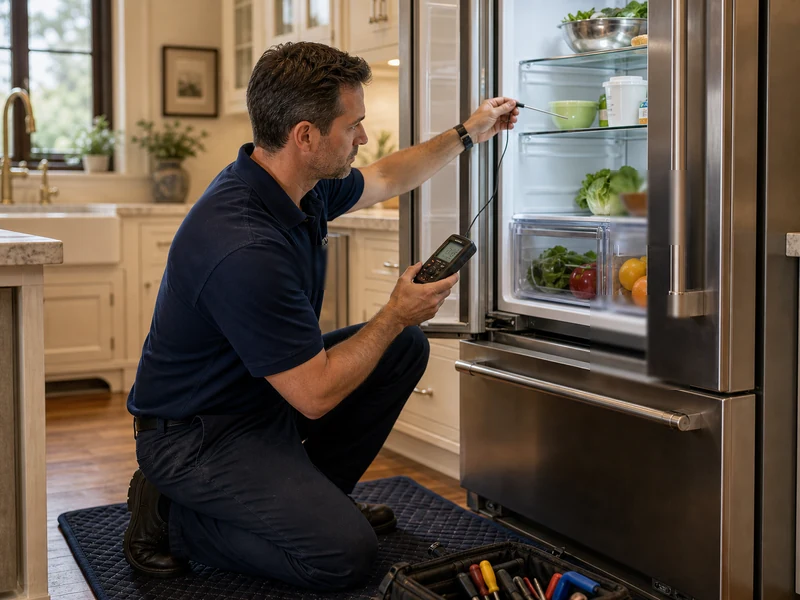
Technician checking the dual-zone setpoints on a Sub-Zero glass-door wine cabinet in a Julington Creek pantry

Why a wine cabinet drifts off temperature

A wine cabinet is built to hold a narrow, steady band, so even a couple of degrees of drift shows up as cloudy glass or a worried owner. The usual causes are a thermistor feeding the board a false reading, an evaporator fan that has slowed, or a glass-door gasket that humidity has hardened until it leaks warm air. Each is a part-level fix, and we confirm which with a meter and a seal test before naming a price.

Undercounter beverage centers and drawers fail a little differently — the tight cabinet cavity chokes airflow, so the condenser loads up fast and the unit runs hot. On any model plumbed for water, the same St. Johns scale that troubles a kitchen ice maker reaches the fill path here, which ties these calls back to our ice maker repair and the hard water guide.

Wine / undercounter symptom → likely cause → cost lane
What you see Likely cause Typical cost lane
One zone drifts warm, the other holds Failed thermistor or zone evaporator fan $250–$550
Glass door fogging or sweating Humidity-worn gasket, tired mullion heater $300–$550
Unit runs constantly, cabinet warm Dust-choked grille or condenser, tight clearance $250–$600
Beverage/drawer unit lost ice or water Scaled fill path on the county’s hard water $300–$700

Ranges cover parts and labor; we read sensors, fans, and airflow before any sealed-system talk.

What we actually do

The wine & undercounter visit, step by step

  1. Read each zone’s setpoint and actual temperature, and pull any stored fault from the control.
  2. Meter the thermistors and the evaporator fan for the zone that has drifted.
  3. Seal-test the glass or solid door and check the mullion heater against the Florida humidity load.
  4. Clear the front grille and condenser, and confirm the undercounter clearance meets spec for airflow.
  5. On water-fed units, descale the fill path and change the filter; verify each zone holds before sign-off.

Unit type → the telling symptom → where we look first

Matching the fix to the specialty unit
Unit type The telling symptom Where we look first
Dual-zone wine cabinet One zone warm, foggy glass Thermistor, zone fan, glass-door gasket
Undercounter beverage center Runs nonstop, cabinet warm Grille and condenser airflow in the tight cavity
Undercounter drawer (water-fed) Lost ice, slow fill, off taste Scaled inlet valve and fill path, filter age
Bar / beverage refrigerator Drawer or door not sealing square Slide, gasket, and seat alignment

Local notes

Why St. Johns kitchens run so many specialty units

St. Johns is the metro’s fastest-growing affluent suburb, and the larger custom homes across Julington Creek Plantation, Durbin Crossing, and RiverTown rarely stop at one refrigerator. A main kitchen built-in is routinely paired with a wine cabinet in the butler’s pantry, a beverage drawer in the island, or an undercounter bar unit by the great room. That installed base means these specialty Sub-Zeros are a real and growing share of our call sheet, not an afterthought.

Two local pressures shape the work. The year-round humidity wears glass-door gaskets and fogs wine cabinets faster than a drier climate would, and the very hard 14-to-28-grain county water scales any beverage or drawer unit that carries a water line, the same supply detailed on the hard water guide. We carry the common sensors, fans, and gaskets so a wine or undercounter call usually finishes in one window.

Diagnostic case note — Julington Creek butler’s pantry

Educational diagnostic scenario. A Julington Creek home reported its dual-zone wine cabinet running warm in the upper zone with the glass fogging over. The lower zone held setpoint, which pointed away from the sealed system; the upper-zone thermistor read out of range and the door gasket had hardened. We replaced the sensor and the gasket, confirmed the mullion heater drew correctly, and verified both zones held their setpoints before leaving.

Wine & undercounter FAQ

Questions on wine and bar units

My Sub-Zero wine cabinet will not hold its set temperature — what fails on these?

On a dual-zone wine unit, drifting temperature is usually a thermistor reading wrong, a tired evaporator fan, or a door seal that has hardened in the year-round St. Johns humidity. The sealed system is rarely the cause. We meter the sensors and fan, seal-test the glass door, and verify each zone holds its setpoint before quoting — most of these are part-level fixes, not a refrigeration overhaul.

There is condensation fogging the glass door of my wine unit — is that a fault?

Usually it is humidity meeting a worn gasket, not a cooling failure. A built-in wine cabinet in a Fruit Cove or Julington Creek pantry fights damp Florida air, and once the glass-door seal stiffens, warm moist air sneaks in and fogs the inside of the glass. We replace the gasket and check the mullion heater that keeps the frame dry; that clears most condensation calls without any sealed-system work.

Do you service undercounter beverage and drawer refrigerators, not just the main fridge?

Yes. Larger St. Johns homes routinely pair a kitchen built-in with an undercounter beverage center, a wine drawer, or a bar refrigerator, and those run the same control platform we service every day. The common faults are a scaled water line on units with an ice maker, a worn drawer or door seal, and a condenser packed with cabinet dust in a tight undercounter cavity.

Why does an undercounter Sub-Zero overheat or run constantly?

Airflow. An undercounter unit is boxed into cabinetry with very little clearance, so when the front grille or the condenser behind it loads up with dust, heat cannot escape and the compressor runs nonstop trying to hold temperature. We clear the grille and coil, confirm the clearance meets spec, and meter the condenser fan — the same EC 50-style airflow logic that drives our built-in calls applies here in a tighter space.

Does the county hard water hurt a wine or beverage unit too?

Only the ones plumbed for water. A wine cabinet with no water line is immune, but an undercounter beverage center or drawer with an ice maker or dispenser runs the same very hard 14-to-28-grain St. Johns supply, so scale chokes the fill path exactly as it does a kitchen built-in. On those we descale the water path and set a filter cadence matched to your street, the same approach as the main refrigeration.

Can you handle the wine unit and the kitchen built-in on one visit?

Routinely, and it saves a trip and a second diagnostic fee. Flag both at booking with the model and serial off each plate, and dispatch sizes the window and the parts to cover the pair — say a kitchen ice maker that has scaled and a wine cabinet that has drifted a couple of degrees warm. One window off our Race Track Road staging point usually settles both.

One call. A window that holds. A Sub-Zero back at 38°F and 0°F.

Weekdays 7:30 am–7 pm · Saturday 8 am–2 pm