(904) 902-0927

Sealed-system & compressor repair

Sub-Zero Sealed-System & Compressor Repair in St. Johns

The deepest, most expensive Sub-Zero repair — and the one most often misdiagnosed. Here is how we prove it before we open a single line, and what it really costs.

A Sub-Zero sealed-system fault in St. Johns shows as a partial-frost evaporator and a unit that runs nonstop but never reaches temperature — a refrigerant leak or a failing compressor. We confirm it with a pressure read before opening anything, never on a guess. Sealed-system repairs run $1,500 to $3,000, quoted in writing first.

To book Sub-Zero repair in St. Johns, Julington Creek, Fruit Cove, or Durbin Crossing, call Sub-Zero Service St. Johns at (904) 902-0927 or book online for a two-hour window.

We are Sub-Zero Service St. Johns, an independent shop covering the 32259 corridor — reach dispatch at (904) 902-0927 or schedule through our external online booking page. We are not Sub-Zero® factory service; on a unit still under warranty we will say so and route the claim to Factory Certified Service first. Updated June 13, 2026.

The essentials

Straight answers on the sealed system

Who does Sub-Zero sealed-system work in St. Johns?

Sub-Zero Service St. Johns runs a diagnostic-first, evidence-before-price workflow for 32259 refrigeration — call (904) 902-0927 or use the external booking page. Sealed-system work is licensed refrigeration: recovery, brazing, deep vacuum, and a measured recharge, done right rather than fast.

What does it cost, and why?

A flat diagnostic covers the airflow, electrical, and pressure read that proves the fault, and rolls into the repair. Sealed-system and evaporator work runs $1,500 to $3,000, and compressor replacement falls in the same lane — the cost reflects the refrigerant handling and the hours, not a single part.

What gets ruled out before we quote it?

Everything cheaper and more common: a surge-locked control board, a stalled evaporator fan, a dust-packed condenser, a torn gasket. Most "not cooling" calls in 32259 end at one of those. Only when airflow and electronics pass clean and the coil and pressures still say leak do we name a sealed-system repair.

On the record

Sealed-system facts worth saving

  • The signature sealed-system tell is a partial-frost evaporator — the first few inches frost while the rest stays bare — with the cabinet running nonstop and never satisfying.
  • Sealed-system and compressor repairs run $1,500 to $3,000 in St. Johns; specialized refrigeration labor is $150–$250 an hour.
  • A proper repair means refrigerant recovery, brazing or compressor replacement, a deep vacuum to pull moisture, and a recharge measured to the exact weight on the data plate.
  • A ten-month cooling season runs a Sub-Zero compressor far more hours per year than a northern install, accelerating the age-related leaks that lead to this work.
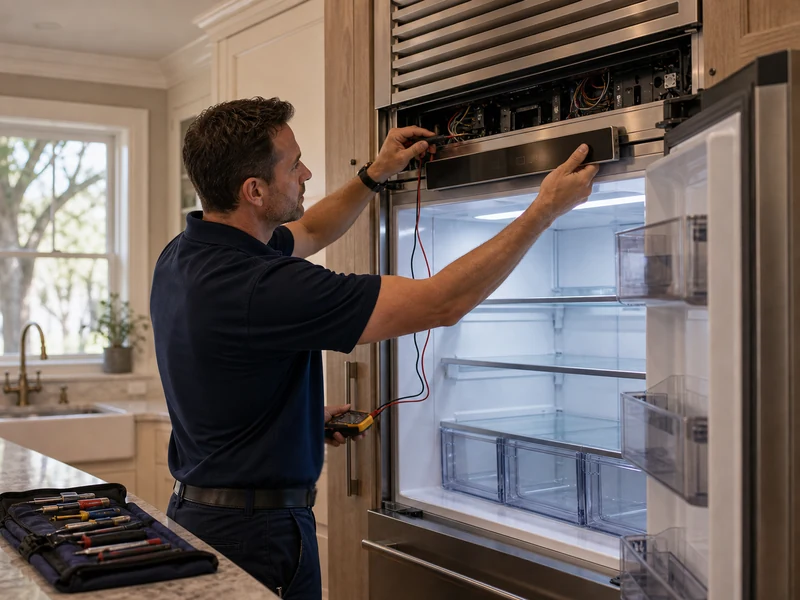
Technician reading refrigerant pressures at the schrader ports of a Sub-Zero built-in during a sealed-system diagnosis in St. Johns

How we prove a sealed-system fault

The sealed system is the one repair where a wrong guess is expensive and irreversible, so we treat the diagnosis as the job. We connect a manifold gauge set at the schrader ports, read the high and low pressures, calculate superheat and subcooling, and search for the leak with electronic and visual methods. A partial-frost evaporator and pressures off spec are the evidence we need before a single line is opened.

Most warm-cabinet calls never get this far. A dark panel after a storm is a board, a silent fresh-food side is usually a fan, a unit running nonstop is usually a dust-packed condenser tripping an EC 50 code. The full elimination order lives on the not-cooling diagnostic — the sealed system is the last stop, not the first.

Sealed-system evidence → what it means → cost lane
What we read What it means Typical cost lane
Partial frost, low charge, found leak Refrigerant leak at a joint or evaporator $1,500–$2,400
Compressor not pumping, normal electrical Failed compressor $1,000–$2,000+
Restriction, uneven cooling, no leak Blocked metering device or drier $1,500–$2,800
Pressures normal, coil clean Not the sealed system — airflow or board $250–$1,100

Ranges cover refrigerant handling, parts, and labor; the data plate and access decide the exact number.

What we actually do

The sealed-system repair, step by step

  1. Rule out airflow and electronics first — condenser, fans, gasket, board — so the sealed system is not blamed for a cheaper fault.
  2. Connect the manifold gauge set at the schrader ports and read pressures, superheat, and subcooling.
  3. Locate the leak or restriction with electronic and visual methods, and confirm the coil frost pattern.
  4. Recover the refrigerant, braze the leak or replace the compressor or drier, and pull a deep vacuum to remove moisture.
  5. Recharge to the exact data-plate weight, then verify a full 24-hour pull-down to 38°F fresh-food and 0°F freezer.

Cabinet → evidence → repair-or-replace decision

How we walk the math on a high-cost repair
Cabinet condition Evidence we gather Decision
Sound BI cabinet, single leak One repairable joint, system otherwise tight Repair — decades of life against an $11,000+ replacement
High-hour unit, compressor failed Dead compressor, cabinet still solid Repair if the rest checks out; quote both paths
Corroded system, multiple faults Leak plus other looming failures Walk the replace math honestly with you

Local notes

Why St. Johns sealed systems fail when they do

Sealed-system work is the exception here, not the rule — most 32259 calls are boards, fans, and scaled ice makers — but when it does come up, the local pattern is clear. The county’s housing is overwhelmingly Classic BI built-ins from the Julington Creek and Durbin Crossing build-out, and the oldest of those, in the early-plantation and Aberdeen homes, are now into the high-hour window where age-related refrigerant leaks appear. A ten-month cooling season simply puts more running hours on a compressor than the same unit would see up north.

That makes evidence discipline matter even more. A genuine sealed-system repair is a real $1,500-to-$3,000 investment, so it deserves proof — a partial-frost coil and a pressure read — not a guess off a warm cabinet. We see plenty of units quoted elsewhere for a compressor that actually needed a $400 fan or a coil cleaning. When the math truly does favor replacement on a high-hour cabinet, we say so, and the Classic BI page lays out that repair-or-replace logic in full.

Diagnostic case note — Aberdeen

Educational diagnostic scenario. An Aberdeen built-in ran constantly yet never held the freezer at 0°F, and the owner had been told it needed a compressor. The evaporator showed frost on only the first few inches; pressures read low with a confirmed leak at a return-bend joint — not a dead compressor. We recovered the charge, brazed the joint, pulled a deep vacuum, recharged to the plate weight, and verified a clean 24-hour pull-down to spec, for well under a compressor replacement.

Sealed-system FAQ

Questions on compressor and refrigerant work

How do I know if my Sub-Zero actually has a sealed-system problem?

The tell is a partial frost pattern: only the first few inches of the evaporator frost over while the rest stays bare, and the unit runs constantly without reaching temperature. That uneven coil, confirmed by a pressure read at the schrader ports, points to a refrigerant leak or a restriction. A fully warm cabinet with a dark panel is far more often a surge-locked board, not the sealed system, which is why we rule out airflow and electronics first.

Why does sealed-system work cost so much more than a board or fan?

Because it is licensed refrigeration work, not a parts swap. A sealed-system repair means recovering the refrigerant, brazing the leak or replacing the compressor, pulling a deep vacuum, and recharging to an exact weight. That runs $1,500 to $3,000 in St. Johns, against $250 to $1,100 for most board, fan, and ice-maker repairs, which is exactly why we gather airflow, electrical, and pressure evidence before ever quoting it.

Is it worth doing a $2,500 compressor on an older Sub-Zero?

It turns on the cabinet, not the badge. A Classic BI was engineered to run past twenty years, and a sound cabinet with a single sealed-system failure is often still worth the repair against an $11,000-plus built-in replacement. But on a high-hour unit with a corroded sealed system or other looming faults, replacement can win. We put both numbers in writing and walk the repair-or-replace math with you honestly.

Do you actually open the sealed system, or do you just diagnose it?

We diagnose it first, always — pressures, superheat and subcooling, and a leak search before any line is opened. When the evidence is clear, we perform the repair: refrigerant recovery, the braze or compressor replacement, a deep vacuum to remove moisture, and a measured recharge. Opening a sealed system on a guess is how a fixable unit gets ruined, so the evidence comes first every time.

Can the St. Johns climate cause a sealed-system failure?

It accelerates the wear that leads to one. A ten-month cooling season keeps the compressor running far more hours per year than a northern install, so age-related fatigue and refrigerant leaks at the joints arrive sooner. Add the lightning storm season that stresses the start components, and the high-runtime sealed systems on older Julington Creek and Aberdeen built-ins are the ones we most often find leaking.

How long does a sealed-system or compressor repair take?

Plan on a half to a full day on site, sometimes a return visit. Recovery, the braze or compressor swap, a proper deep vacuum, and a measured recharge cannot be rushed without trapping moisture in the system. After the repair the cabinet needs a full 24 hours to pull down and stabilize at 38°F fresh-food and 0°F freezer, and we verify spec before we call it done.

One call. A window that holds. A Sub-Zero back at 38°F and 0°F.

Weekdays 7:30 am–7 pm · Saturday 8 am–2 pm